EST Case Study
Film Distribution Across Markets
International sales, distribution strategy, and cross-cultural positioning for Asian films moving across territories.
What I worked on
-
Buyer outreach
-
Deal announcements
-
Contract review
-
Cross-market positioning
Context
As someone who started on the creative side of filmmaking, transitioning to the business side revealed how art turns into a product.
Distribution is the process of turning art into cultural commodities. From DVD to streaming, technological evolution has diversified distribution beyond theatrical releases. However, gone are the days when a great film and a festival screening guaranteed a distribution deal. The film festival's prestige cannot satisfy the saturated market and low barrier to entry due to technological advances such as AI.
EST Studio, an international sales and marketing company, connects Asian-representing films with global distributors. My role was to understand how to turn creative projects into viable business assets. I came to see distribution not just as the endpoint of production, but as the discipline that determines which stories reach the world and through what platforms.

Revenue Model
“Timing turn stories into predictable value."
Relationship Model
“Trust precedes every transaction.”
Cross-Cultural Model
“Translation begins long before language.”
The Revenue Model: Turning Creativity into Predictable Value
As a startup, EST Studio built its foundation on small-budget (< $2M) genre films to establish credibility while managing financial risk. Rather than chasing prestigious titles, the company prioritized consistency and volume, echoing A24’s early “low cost, high output” model that balanced creative discovery with financial prudence.
In the independent space, cross-border box office data is often opaque, and smaller titles often lack marquee attachments (recognizable directors or actors) that attract pre-sales. This structure explains why independent distributors lean toward the “minimum guarantee model” — an upfront cash flow to recoup acquisition costs — than the “revenue-sharing” model common among major studios. My experience drafting and reviewing distribution contracts helped me understand how these financing structures shape the entire risk-reward equation of independent filmmaking.
Through daily buyer outreach, I discovered that festival awards and highlights are not the whole story; language, genre, territory, and especially timing contribute to a film’s market value. “Timing” operates on two dimensions:
Seasonal
Unless it’s a category like documentary or arthouse, distributors would lose interest as titles age. In addition, most buyers aim to fill their plates by mid-summer and make purchasing decisions in a time window. Hence, a strong title can lose traction simply for arriving late. Monitoring those cycles taught me to treat each outreach window as a perishable opportunity.
Real-time bidding
Once a single buyer signals interest, the clock accelerates. Rights are divided across formats — AVOD, SVOD, airline, and all-rights — so momentum matters. When a proposal landed, I immediately alerted other distributors in the same territory to ignite competitive bidding. Occasionally, the presence of a major OTT platform like Shudder triggered a cascade of offers from smaller buyers eager to secure adjacent rights.
Learning to read and respond to these time signals taught me how scarcity and urgency act as commercial leverage, transforming creative assets into commercial value. This shows me that, beyond artistic quality, there are other factors within my control that can elevate the titles’ value.

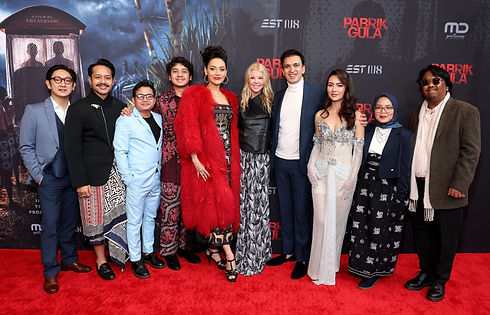
Indonesian Horror Films ‘Pabrik Gula’ and ‘Perewangan’ Acquired by Shudder From EST N8
I finalized this trade-facing announcement to turn buyer interest into broader market momentum. Once Shudder entered the picture, I supported outreach in overlapping territories to reinforce urgency and accelerate sales conversations.
Commercial Value:
The announcement helped convert momentum into commercial leverage.
The Relationship Model: Trust Before Transactions
One takeaway from the creative world that applies to the business world is that it’s inherently collaborative. Besides numbers, success depends on soft skills such as credibility, patience, and endurance. Relationships often outlast film projects, since one may take years to come to fruition or, if it does, materialize at all. Therefore, the investment is more than a financial aspect; it is personal, with time and energy hinging on trust. However, the world of distribution, especially internationally, is filled with uncertainty. For instance, no one could have foreseen the success of Taiwanese film The Pig, the Snake and the Pigeon in Mainland China. With greater stakes come greater gains. Investing in the future, starting from today, was a crucial lesson for me.
As a beginner, I treated IMDbPro as a dictionary of all creatives and film projects. By tracing how producers met directors and how creative partnerships evolved over time, I began to see how trust compounds. Patterns emerged as to which films got funded, stuck in developmental hell, or crossed borders.
One of these patterns is geography. For instance, CJ Group’s Vietnam-Korea joint venture leveraged cost advantages and regulatory access by moving Korean production (with high production costs) to Vietnam (a market that gate-keeps foreign entities). This is an example of how partnerships bridge creative ambition with market-entry barriers.
Bridge-crossing goes two-way:
On one hand, it can bring domestic hits to an international stage, reaching a diverse viewership and resulting in higher returns. EST partnered with MD Pictures, a top Indonesian production company, to release Pabrik Gula theatrically in the U.S. The campaign generated significant social media impressions, yet the box office performance fell flat.
Looking back, the gap wasn’t due to visibility but to audience misalignment. We had targeted isolated AMC theaters with high minority demographics, assuming community support would drive attendance. In reality, the horror film audience in the U.S. is cult genre enthusiasts, not a specific ethnic community. The focus on culture identification rather than the genre affected turnout. This is why heavy emphasis is placed on market fit and localization.
On the other hand, EST distributes Western films such as Ferrari in Thailand and in Myanmar, widening exposure through regional networks. There was a localization effort to promote the film in Thailand and Bangkok with A-list stars.
Together, these cases taught me that success in cross-border distribution depends less on production scale and more on cultural translation and market trust. A distributor’s real value lies in anticipating what travels before contracts are signed.
The Cross-Cultural Model — Translating Meaning Across Markets
EST’s acquisition strategy is built on universality — selecting genre films (romcom, horror, action, and drama) whose narratives transcend borders. This approach also shapes how the acquisition team evaluates new titles: which stories can resonate across cultures with minimal localization.
The company’s decision to hire multilingual and internationally minded staff reflects that strategy. My own cultural background equipped me with knowledge of the domestic market, from understanding how Chinese audiences consume content to negotiating directly with Mandarin-speaking buyers. Working with colleagues from Southeast Asia also revealed market nuances, such as the Philippines’ challenge in promoting domestic films to an English-fluent population accustomed to imported media. The imported media require minimum localization (no subtitles). The best slots at the theaters are reserved for foreign films while domestic ones occupy midweek slots. These realities underscore how language proficiency and local preference shape not only viewing habits but also distribution potential.
In acquisitions, cross-cultural adaptability is tested during post-production conversations with buyers. A film’s marketability can hinge on adjustments as subtle as a character’s name. Reviewing rough cuts from Mongolia, Vietnam, Indonesia, and China taught me to evaluate each project not just for creative merit but for negotiation leverage: what could be refined to meet buyer expectations without diluting artistic intent.
Through this process, I came to see translation as a form of editing and adaptation for emotional resonance. Translation, in this sense, is not an afterthought but a core distribution strategy: the art of making meaning travel while preserving what makes it worth buying.
Reflection
Working at EST N8 gave me a front-row seat to how films become assets that travel across cultures.
Through the Revenue Model, I learned to quantify creativity: understanding how minimum guarantees, timing, and buyer psychology convert stories into financial outcomes.
Through the Relationship Model, I learned that distribution isn’t just about transactions — it’s built on trust, patience, and cultural empathy that precede every contract.
And through the Cross-Cultural Model, I saw that translation extends beyond words; it’s the strategic editing of meaning to make art commercially resonant in new markets.
Whether I’m negotiating a deal, crafting a pitch deck, or consulting on cross-border projects, I now approach every problem with the same mindset: bridging the gap between cultural authenticity and market strategy.